STOCKWISE Structuring orders and inventory without pulling sellers away from WhatsApp
The context
Many sellers use WhatsApp as their main sales channel.
The problem appears as volume grows: orders end up in different conversations, inventory is tracked by hand and customer information becomes hard to find.
Stockwise was born to solve this: bringing management structure to a sales process that already happens on WhatsApp.
The problem
The seller had to juggle several pieces of information at once:
- orders
- products
- inventory
- customers
- payments
- sales tracking
Part of this information was handled directly in conversations or by hand.
The goal was to create a system simple enough to use quickly, while still bringing real management structure.
The constraints
The solution had to:
- let sellers create an order quickly
- automatically manage available quantities
- avoid inventory inconsistencies
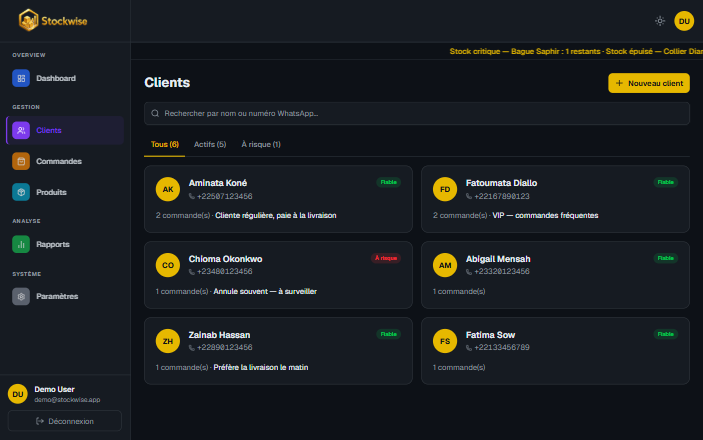
- keep customer information
- give an overall view of the business
- stay accessible from a phone
- not force the seller to install a heavy app
The solution
I built Stockwise as a web app that can be installed from the browser.
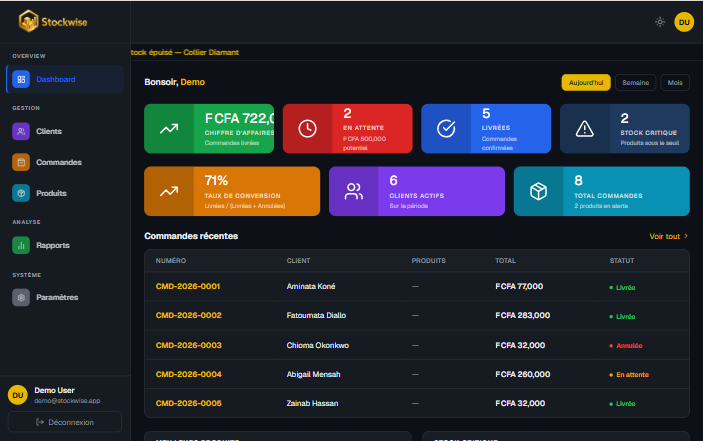
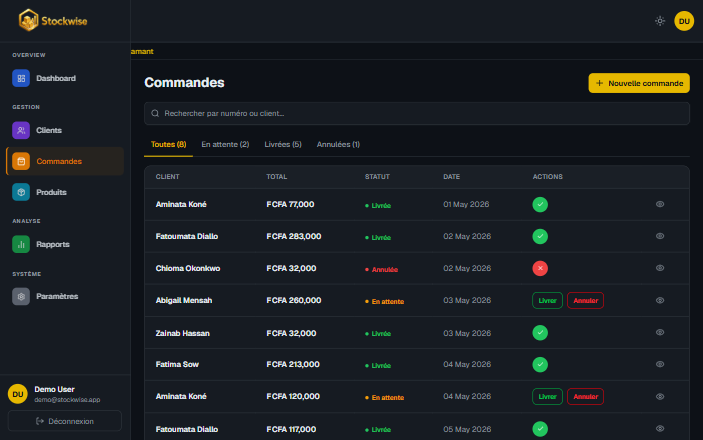
The system centralizes products, customers and orders.
Inventory management also follows the order lifecycle: a quantity can be reserved when an order is created, deducted when it's completed, and released back when it's cancelled.
The dashboard then lets sellers track different business indicators and spot the products that need attention.
PDF and Excel exports also let them pull the data out for external tracking.
An important decision: reducing friction
One of the most important lessons of the project came from real-world use of the product.
An app can solve a technical problem perfectly well while adding a new step to the user's day.
In the first version of Stockwise, the seller still had to open the app to record an order. The system worked, but it added extra friction since the conversation with the customer was already happening on WhatsApp.
This observation shaped the thinking behind the product's next evolution: reducing manual input even further.
The next evolution
In developmentAn AI-powered version is currently in development.
The goal is to let the system interpret certain order messages directly, so it can prepare the information needed to create an order automatically. For example, a message like “I want 2 blue pagnes” could be turned into order data automatically.
This feature is still in development and is therefore not presented as a feature that has been delivered.
The results
What this project taught me
The most important thing is not always to add more features. Sometimes the real improvement is to remove a step.
Stockwise taught me in particular to look at an app from the point of view of the user's real workflow: where do they already work? What do they do today? Which step still demands unnecessary effort?
That thinking now guides the product's evolution.
Working with Yaji NONFON was an excellent experience from start to finish. He built the entire Mp Recharge platform, a robust and fully functional solution that now serves more than 100 active users. Throughout the project, he showed strong technical skills, met every deadline and kept communication clear and professional.
Elias Soglohoun — Founder, MPAY
Review published on May 21, 2026. The platform now has more than 250 active users.
Does your business still rely on WhatsApp, Excel, files or manual tasks?
Describe how you work today. Together we can look for the steps that can be simplified or automated.